Reviewed · OLD TOWN WALKING TOURS
Fall in Love with Munich in a Private Old Town Walking Tour
This private Munich old town walk is interesting because it strings together medieval walls, royal courtyards, and one of the world’s most famous beer halls in just two hours. You get a tight route through the center, plus the kind of local context that makes the streets feel like a living story, not a list of sights.
I love that it is a true private walk for up to 6 people, so the pace can match your day. I also love that Victoria uses visuals on her iPad and keeps the talk engaging, even when the group includes kids, grandparents, or teenagers.
One drawback to consider: this is a walking tour focused on stops and stories, not a food-and-drinks crawl. If you want lots of tastings, you’ll need to plan those on your own after the tour ends at Marienplatz.
Key things that make this tour worth your time
- A small private group (up to 6) means you get real back-and-forth, not just one-way facts.
- Victoria’s storytelling style brings politics, beer culture, and legends to the same level of clarity.
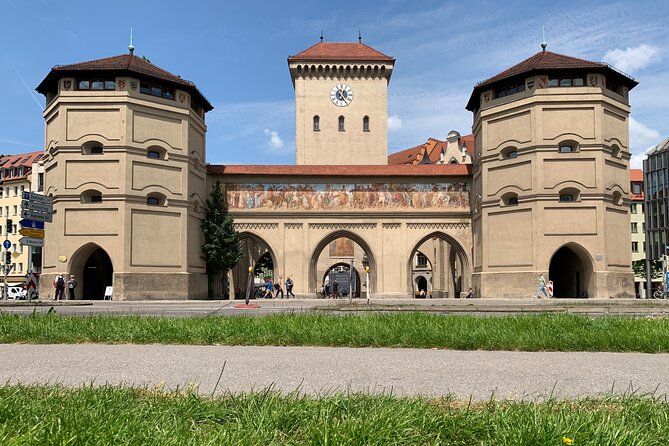
- The route is built for first-time bearings, starting at Isar Gate and finishing at Marienplatz.
- Entrance fees are handled, so you are not hunting ticket counters mid-walk.
- Practical recommendations for restaurants, coffee, and what to do next in Munich are part of the experience.
- The pace is flexible, with smart check-ins for long travel days and mixed-age groups.
A Two-Hour Old Town Walk That Actually Helps You Understand Munich
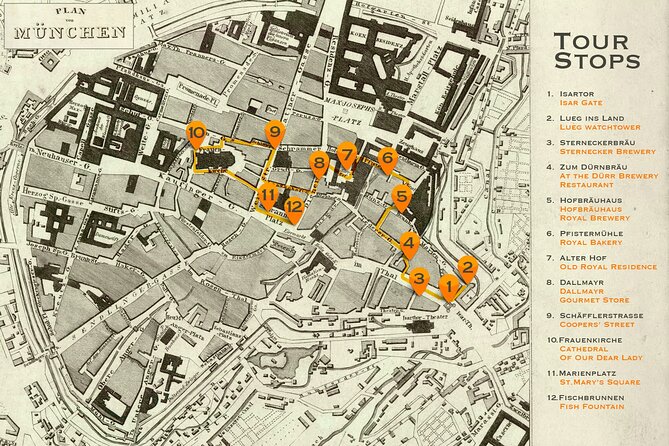
If you are short on time and you want Munich to make sense fast, this tour hits a sweet spot. You start at Isar Gate and end in Marienplatz, the main square where the city’s energy and history overlap. In two hours, you cover enough ground to get your bearings, then Victoria’s suggestions help you keep exploring on your own.
What makes the experience work is the guide’s approach: she explains how places connect. You do not just see a gate, a church, or a beer hall. You learn why they mattered, how legends grew around them, and what locals still talk about today. That is the difference between collecting photos and understanding the city.
This is also a good choice if you have a mixed group. The tour is designed to keep everyone engaged, and there is room for small needs like taking a bathroom break mid-way.
More old town walks in Munich:
- Munich: Old Town & Viktualienmarkt City Walk in German
★ 4.7 · 2,304 reviews - Munich Old Town Walking Tour
★ 4.5 · 1,287 reviews - Munich: Spooky Tour of Old Town in German
★ 4.6 · 1,112 reviews
Private Walking Means You Can Set the Pace (Up to 6 People)
This is a private tour for your group, capped at 6. That matters in Munich, where “quick sightseeing” can turn into a stressful shuffle if you are stuck with a rigid schedule. Here, the conversation stays human and responsive, and the walk feels tailored to your rhythm.
I like that the guide can adjust for real-life factors. One big theme from the experience is flexibility, including accommodating groups with a 6-month-old and also grandparents. It is also the kind of tour where teenagers can stay interested, because the stories are not just dry dates and names.
Best part: you get recommendations that are useful right away, not generic “you should go here” tips.
Isar Gate, Munich’s Medieval Walls, and the Legends That Color the Streets
You meet under the central arch of Isar Gate at Tal 50. This is a smart starting point because it frames Munich’s medieval beginnings right away. From there, you get a guided look at what remains of the old fortifications and how the city’s growth took shape.
A few of the stories you will hear at this stop stand out. You’ll learn a legend tied to Munich’s foundation and how trading one key product helped the city rise into a bigger metropolis. You also hear the local twist on time in Bavaria, plus the idea that humor has a home here too, with a comedian’s museum hosted by the Isar Gate towers.
If you are the type who likes context, this first stop does a lot of heavy lifting. It turns the old stone into a map of cause and effect, why defenses were where they were, and how trade shaped what grew next.
Sterneckerbräu: When Munich’s Walking Tour Touches Nazi History
Next comes Sterneckerbräu, a stop that adds seriousness without turning the walk into a lecture. You will spot the place linked to Adolf Hitler’s first public speech, which connects Munich to the early steps of the Nazi movement. The guide then brings the story forward to how the building evolved into a key location for the party.
This part of the tour matters because it teaches you how to read the city with honesty. Munich is not only beer halls and cheerful squares. It also has chapters of history that are painful, and you need the context to understand why certain sites carry weight.
If you prefer a tour that stays purely light, this stop might feel like a necessary interruption. But it is brief, and it helps you see the city in full, not just in postcard mode.
More walking tours in Munich:
- Munich: Third Reich & WWII Walking Tour
★ 4.6 · 6,181 reviews - Third Reich Walking Tour Munich
★ 4.5 · 4,291 reviews - Munich: Night Watchman Walking Tour
★ 4.7 · 2,092 reviews - Munich Ghosts and Spirits Evening Walking Tour
★ 5.0 · 1,900 reviews
Dürnbräugasse and an Old Tavern That Survived for Centuries
At Dürnbräugasse, you pass by what is said to be the oldest tavern in town. The point is not just the age badge. It is the resilience story: how a place like this manages to keep its identity over more than half a millennium.
This stop is short, so it fits smoothly into the walk. It also gives you a sense of how Munich’s drinking culture is rooted in long-standing habits, not just modern tourist beer rituals.
Hofbräuhaus München: The Royal Brewery, Beer Culture, and the Beer Angel
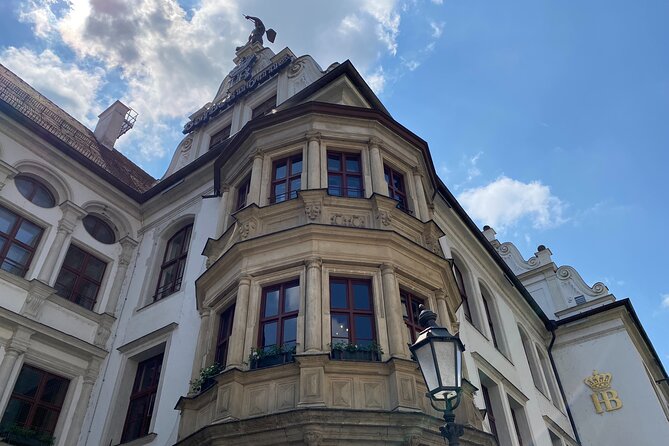
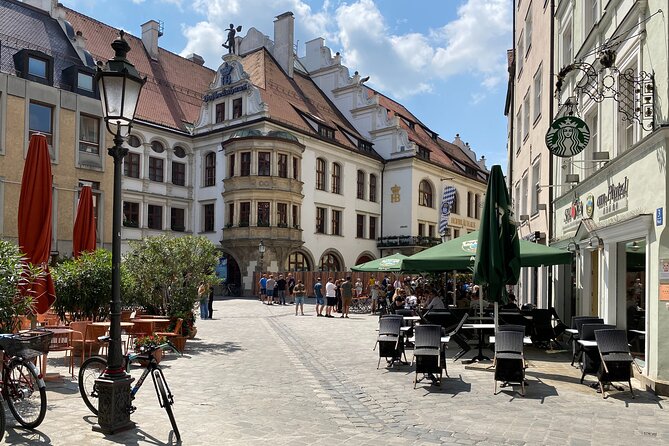
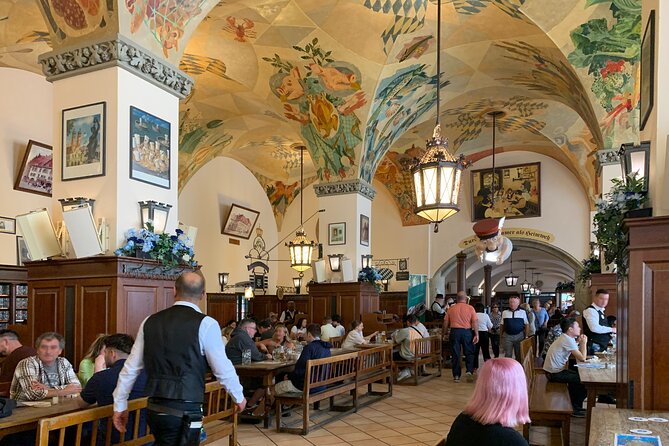
Then you reach Hofbräuhaus München, the former royal brewery that became one of the world’s most famous beer halls. This stop is longer, and it is the heart of the experience for beer lovers and culture fans alike.
Inside the main hall, you are meant to look around, not just listen. You can admire the interiors, spot the regular tables, and see how beer mugs of regulars are stored in special cells. That detail alone gives you a feel for how the hall works as a social institution, with continuity across generations.
You will also learn stories tied to Bavarian brewing traditions and the beer purity law. The guide connects that heritage to modern beer culture, including Oktoberfest and the way Munich’s beer gardens function. You also hear about the beer angel, a feature that adds a touch of myth and local character to the serious business of brewing.
This stop is best if you like your history with atmosphere. You come away with a better sense of why people treat beer halls like more than drinking venues.
Pfistermühle and the Legend of the Pretzel
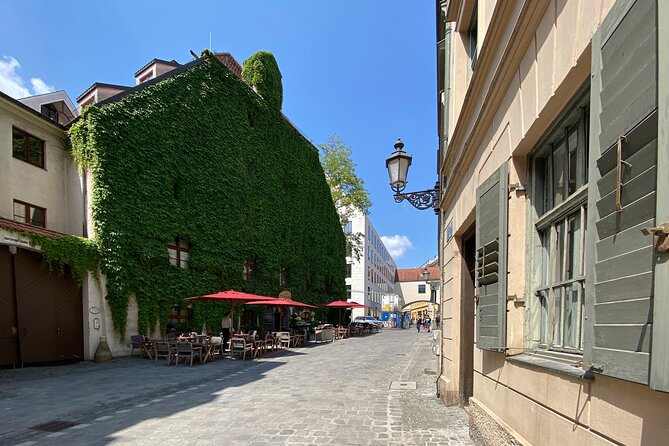
At Restaurant Pfistermühle, you sight the former royal bakery. The guide shares the legend of the pretzel and explains its symbolic connection to Munich.
This is one of those “small stop, big payoff” moments. Even if you do not care about food history, the story helps you see how everyday things become symbols in a city. Munich does that well, and a pretzel is a great example.
If you are traveling with picky eaters, this stop is still useful. It is not a tasting. It is narrative, and it keeps the tour moving while giving you something memorable to remember later.
Alter Hof: The Wittelsbach Courtyard, Louis IV, and Munich’s Flag Colors
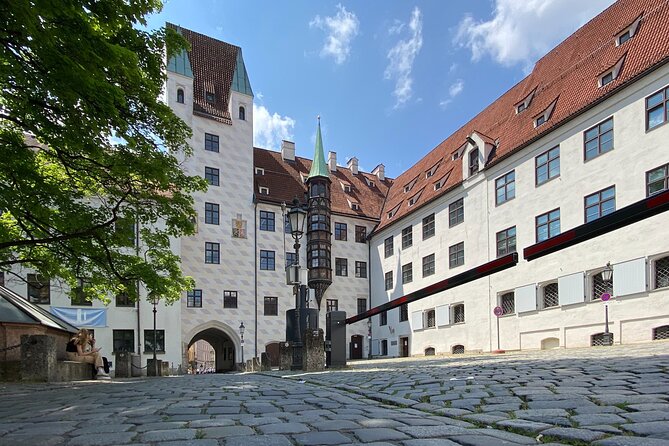
Alter Hof is where the walk shifts deeper into royal territory. You will visit the inner courtyard tied to the first residence of the Wittelsbach royal family in Munich.
Here you hear a legend about the Royal Zoo, including its unexpected role in the life of the Holy Roman Emperor Louis IV. You also learn how Munich’s flag got its colors, which turns an everyday civic detail into a story with real roots.
This stop adds balance. After beer and tavern culture, you get architecture and power. You also get a reminder that the Bavarian story is not only folk tradition. It is tied to rulers, courts, and the long reach of Central European politics.
Dallmayr Delikatessenhaus and the Food-Obsessed Side of Old Munich
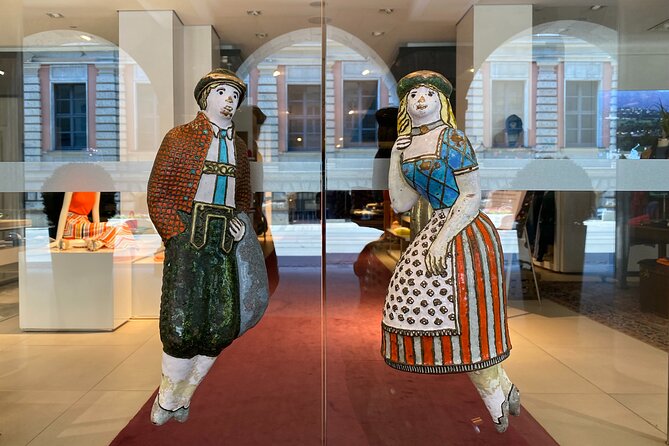
At Dallmayr Delikatessenhaus, you walk past a historical gourmet store with longstanding royal tradition. Today, it is one of the largest delicatessen companies in Europe, but the stop is about more than modern scale.
The guide shares curious details from Dallmayr’s history and connects that heritage to practical food lover tips. You get a feel for where the city’s “serious eating” culture comes from, and you pick up ideas for coffee and delicatessen shopping that you can use later.
If you plan to bring back food items or you care about where locals actually shop, this is a good moment to pay attention.
Schäfflerstraße: Coopers’ Street, Pest Stories, and a Dance Tradition
Schäfflerstraße is short and sweet, but it carries a memorable legend. You cross Coopers’ Street, and you hear Munich’s most famous legend about a 16th-century pest containment celebration.
The story includes a traditional dance performed in the city even until today. That link between crisis, community rituals, and an ongoing tradition is exactly the kind of detail that makes old streets feel alive.
This stop also helps you understand Munich as a place where celebrations are not only for holidays. They can be linked to survival and civic identity.
Frauenkirche: Construction Legends, the Devil’s Footprint, and the Wind Mystery
Frauenkirche is one of Munich’s best-known cathedral landmarks, and the tour gives you a reason to pay attention beyond the obvious exterior. You will learn the legend of its construction and how the interior has its own interesting story.
Two details people often remember are the Devil’s footprint and a secret about wind around the cathedral that happens all year. Even without getting overly technical, those stories give you something to look for while you stand in the space.
This is also a good stop for anyone who wants “history plus fun facts.” You get mythology and real architectural curiosity, packaged in a way that stays clear.
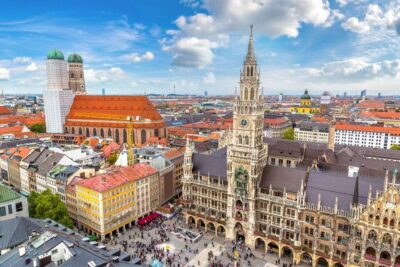
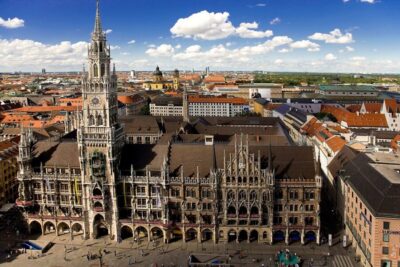
Marienplatz: Fischbrunnen, Sausage Legends, and the Glockenspiel
The tour ends at Marienplatz, and it is a strong finish because it is the classic center of town. You admire the Fischbrunnen, Munich’s most famous fountain, and you learn the local traditions connected to it, including Wallet Washing and Butchers’ Jump.
You also hear where Munich white sausage was invented, plus the circumstances that surrounded the invention. That makes the fountain stop feel less like a photo moment and more like an origin story.
Then comes the Glockenspiel. You get an introduction to the mechanical clock and the two historic scenes it reenacts, along with the tunes of the carillon. It is one of those things you do not want to miss in person, and ending here sets you up to see it again if timing works.
Because the walk finishes at Marienplatz, you are in the right place to continue. The guide’s tips help you choose what to do next without wasting time hunting around.
Price and Value: What $157.28 Buys You in Real Terms
The price is listed as $157.28 per group, up to 6 people, for about two hours. That sounds simple, but it is the structure that makes it good value: you are paying for a private guide, not a per-person add-on.
If you compare it to taking multiple people on separate paid entries or buying a generic audio tour, the value becomes easier to see. You get a guided route, entrance fees handled, and a steady stream of context you can not get from a map alone.
It also helps that the guide includes practical takeaways. You leave with restaurant, coffee, and activity recommendations you can actually use that same day. For many first-time visits, that alone helps you avoid wrong turns.
The one caution is the tour does not include food and drinks. So if you want a meal built into the cost, plan that separately. If you treat it as a history and orientation walk, the pricing feels fair.
When This Tour Fits Best (And When It Might Not)
This experience fits best if you want two hours in Munich that help you understand what you are looking at. It is great for first-time visitors because the route creates a mental map quickly, and it is useful for repeat visitors because the stories and details add layers you might miss on your own.
It is also a solid choice for families with mixed ages, because the pace and storytelling keep different people engaged. If your group includes beer fans, this tour gives you the context behind Munich’s brewing traditions, not just a generic beer hall visit.
What might not fit as well is a traveler who wants pure spontaneity, because the walk is stop-based. Also, if you want a full-on food sampling experience, you will likely want to add that after the tour.
Practical Tips to Make the Most of the Walk
Here are a few practical things that will improve your experience immediately.
Wear comfortable shoes. You are moving through multiple central stops, some of them indoors, and you will want good footing for quick transitions.
Bring a light layer. Munich weather changes fast, and even short cathedral and hall visits can feel cooler than the street outside.
Use your questions. Since it is private for up to 6, this is a chance to ask about Oktoberfest timing, where to go for coffee after you finish, or what else to prioritize beyond Marienplatz.
If you need flexibility, tell the guide early. The experience is set up for a comfortable pace, and the guide can handle small adjustments so the day stays pleasant.
Finally, plan your next step at Marienplatz. Since you end in the central square, you are positioned to keep exploring, grabbing a snack, or catching the mechanical clock show if your schedule lines up.
Should You Book This Munich Old Town Private Tour?
I would book it if you want a fast, well-paced way to understand Munich’s center without feeling rushed. The combination of private time, entrance fees handled, and strong storytelling makes it a great first stop in a short visit. It is also a good “history plus local tips” format, because you finish with clear ideas for what to do next.
I would skip it only if you want a heavy food-and-drinks focus, or if you dislike that a short portion touches difficult 20th-century history. For most people, the route is well balanced, and Victoria’s style makes the city easier to read.
FAQ
How long is the private walking tour?
It runs about 2 hours.
What is the group size for this private tour?
It is private for your group, with up to 6 people.
Where does the tour start and end?
It starts under the central arch of Isar Gate at Tal 50, 80331 München, Germany, and ends at Marienplatz, 80331 München, Germany.
Is the tour offered in English?
Yes, it is offered in English.
What is included in the tour price?
You get a digital map of the itinerary, a knowledgeable and welcoming English-speaking guide, the 2-hour private walking tour, and insider tips and recommendations. Entrance fees are included.
Are food and drinks included?
No, food and drinks are not included.
What is the cancellation policy?
You can cancel for a full refund up to 24 hours in advance of the experience start time.
Is there a mobile ticket?
Yes, the tour uses a mobile ticket.
Recently added around Munich
- München: Vegetarische Viktualienmarkt-Probiertour Deutsch★ 4.8 · 6 reviews
- Private Transfer from Munich to Vienna with 2 hours for sightseeing★ 4.5 · 6 reviews
- Munich Walking Quiz: Explore and Discover the City’s Highlights★ 5.0 · 7 reviews
- Walking Tour on Resistance to Nazism in Munich★ 5.0 · 8 reviews
- 2 hour Sights Guided E-Scooter Tour in Munich★ 4.0 · 6 reviews
- Private Transfer from Munich to Salzburg with 2 hours for sightseeing★ 4.5 · 13 reviews
- From Munich: Neuschwanstein Castle and Linderhof Private Tour★ 5.0 · 13 reviews
- Paul’s Private Tour Munich Highlights★ 5.0 · 3 reviews
Old Town Walking Tours, compared.
Old Town & Viktualienmarkt City Walk in German
Read our review →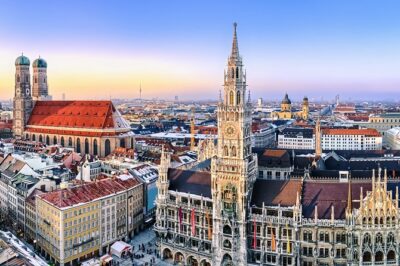


Munich Private Tour with a Local – Highlights & Hidden Gems
Read our review →
Munich City Walk and Oktoberfest Tour With Beer Tent Reservation
Read our review →Browse the lists this tour appears in