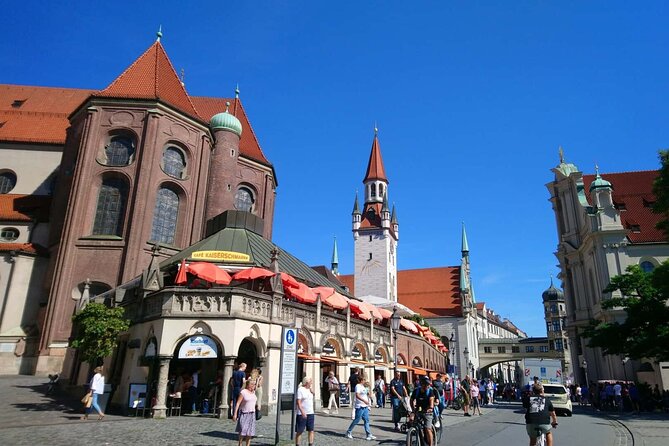
Reviewed · MUNICH BIKE TOURS
Best of Munich Electric Bike Tour
Munich is a city you can understand fast when you see the big planning ideas in the streets. This Best of Munich Electric Bike Tour turns that into a smooth 4-hour ride, swapping tiring walking for pedal assist while your guide ties the architecture to real stories.
I love how the route blends Munich’s art-and-palace core with beer culture and real local park life. I also love that you get a live guide and a bike kit right in the price, so you can focus on the fun parts instead of logistics.
A fair heads-up: this is a highlight loop with short stop time at many major sights, so if you want hours inside museums, plan a follow-up visit.
Key highlights you’ll feel on the ride
- Electric bike makes the whole loop easy, even if you are not a strong cyclist
- Quick hits on major landmarks, from Königsplatz to the Residenz and the English Garden
- Art museums in the Kunstareal area, including Alte Pinakothek and Pinakothek der Moderne
- A thoughtful mix of eras, with stops like the Führerbau still standing today
- Beer garden time at the Chinese Tower, one of Munich’s most famous outdoor spots
- Big-city variety in a few hours, from the Deutsches Museum to Viktualienmarkt and a modern synagogue
Why this Munich e-bike tour is such a good value
At $71.90 per person for about 4 hours, you are paying for three things that matter: a live guide, an electric bike plus helmet, and a route that strings together sights efficiently. A tour like this can easily save you from piecing together transit, timing, and parking, especially in central Munich.
What makes it work is the pacing. The route includes lots of stops, often around 5 minutes, plus a few longer moments for the park and beer garden stretch. That means you see the “what and why” without burning out.
The city setup helps too. Munich is famously flat in the center, and that shows up in the way this tour rides. Even people who felt they might not need an e-bike said the assist still made things comfortable, and it helps a lot when the weather turns cold or wet.
One more practical point: the group size is capped at 20 travelers, and the group may include people on non-e-bikes. That balance is good for control and safety, but it also means you should expect a guided, bunched-up feel during busier segments.
More guided bike tours in Munich:
- Munich 3-Hour Guided Bike Tour
★ 4.5 · 1,731 reviews - Classic Mike’s Bike Tour daily @ 11.30 incl Beer Garden & Surfers
★ 5.0 · 1,246 reviews - Neuschwanstein Castle by Bus Incl. Bike Ride or Hohenschwangau
★ 5.0 · 607 reviews
Starting at Wittelsbacherbrunnen, then rolling into Munich’s planned core
You begin at Karlsplatz 4 and start your ride in a part of town that sets the tone quickly. The first visual anchor is the Wittelsbacherbrunnen, a monumental fountain built between 1893 and 1895. Designed by sculptor Adolf von Hildebrand in a Neo-Classicist style, it is meant as an allegory for the primal forces of water. It is the kind of opener that tells you Munich likes meaning in its monuments.
From there, you pedal toward Karolinenplatz in the Maxvorstadt district. This square is linked to the Strahlenplatz motif, and it also symbolizes Bavaria’s early 19th century relationship with France. It is a small stop, but it is a good example of how Munich mixes art, politics, and geography in one place.
Next comes Königsplatz, where the vibe shifts toward classical grandeur. You see the Propyläen Gate and, facing each other, the Glyptothek and the Staatliche Antikensammlungen. This area sits inside Munich’s Kunstareal gallery and museum quarter, so you are essentially “setting the map” for where the city’s art institutions cluster.
What to look for during these quick stops
- Notice how the guide points out axes, spacing, and views, because Munich often designs streets like corridors between key buildings.
- Use these early stops to orient yourself visually. After that, the rest of the day becomes way easier to navigate on your own.
Kunstareal highlights: Alte Pinakothek and Pinakothek der Moderne
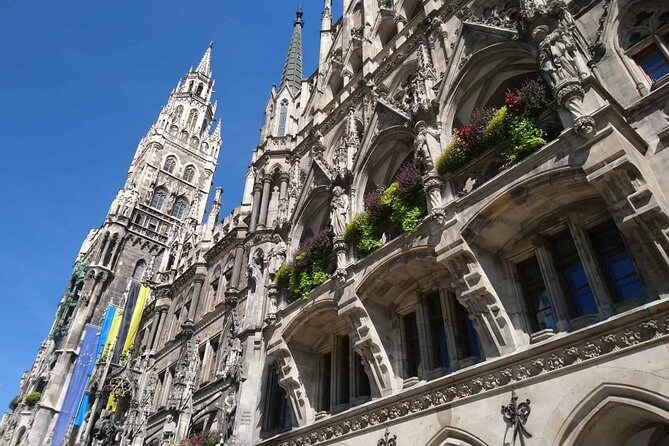
This is the art stop that feels like a mini road trip inside the Kunstareal. You first reach the Alte Pinakothek, one of the oldest galleries in the world, built to house a major collection of Old Master paintings. Your stop time is brief, so treat it as a first look and a reason to return later if you want deeper museum time.
Then you roll into Pinakothek der Moderne. This museum unites multiple collections under one roof, including modern and contemporary art, works on paper, design and applied arts, plus an architecture museum related to the Technical University of Munich. The guide’s job here is to help you understand that the building is not just one museum, it is a cluster of disciplines that Munich groups together for a reason.
A key benefit of seeing both in the same run: you can compare what Munich chooses to highlight across eras. Old Masters on one side, modern thinking on the other. Even if you only get outside views and a short explanation, it helps you decide what to target later.
Also reviewed in and around Munich:
- From Munich: Neuschwanstein & Linderhof Castle Full-Day Trip
★ 4.5 · 12,494 reviews - Neuschwanstein & Linderhof Castle-Fairytale Day Tour from Munich
★ 4.5 · 7,275 reviews - Munich: Third Reich & WWII Walking Tour
★ 4.6 · 6,181 reviews - Dachau Concentration Camp Memorial Site Tour from Munich by Train
★ 4.5 · 5,637 reviews
The Führerbau stop: history you cannot ignore, plus a lesson in how buildings change use
One of the most striking moments on the ride is the stop at the Führerbau on Arcisstrasse 12, in Maxvorstadt. It was built between 1933 and 1937 during the Nazi period and used extensively by Adolf Hitler. Unlike many other Nazi-associated sites, the building still stands, and today it houses the University of Music and Performing Arts Munich.
This can be emotionally heavy. I like that the tour does not skip it, but it frames it in a clear, historical way. You get to see how power leaves physical marks, and you also see how later generations repurpose spaces rather than erase them. That is an important Munich lesson.
If you are the type who reads carefully before you visit, this stop is a good moment to slow down mentally. You are watching history in real time, not just reading it.
Siegestor and Odeonsplatz: memorial architecture and the 1923 Beer Hall Putsch
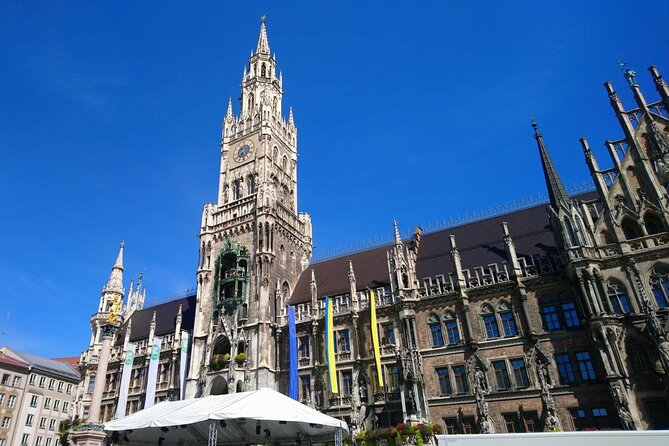
After the art and history core, you head toward the city’s memorial language.
You pass Siegestor (Victory Gate), a three-arched memorial arch crowned with a statue of Bavaria with a lion-quadriga. Originally, it was dedicated to the glory of the Bavarian army. After World War II restoration, the meaning shifts toward peace. It is one of those places where you realize monuments can be rewritten by time.
Then you reach Odeonsplatz, developed in the early 19th century by Leo von Klenze. The square is associated with the former Odeon concert hall and connects visually with Ludwigstraße. This is also where you get the reference point for the fatal gun battle tied to the 1923 Beer Hall Putsch, ending the march toward the Feldherrnhalle. Even if you have never studied that specific event, the place helps it make sense.
Practical tip for this stretch
Streets around Odeonsplatz can be lively. Keep your focus on the guide and the group flow, especially when you are crossing or stopping for photos.
Residenz München and Hofgarten: Munich’s royal spine, from palace rooms to Italian garden lines
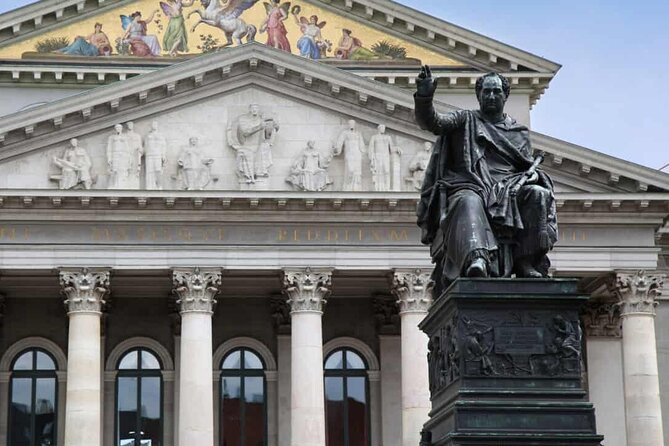
Now you enter the classic Munich “old center” feel.
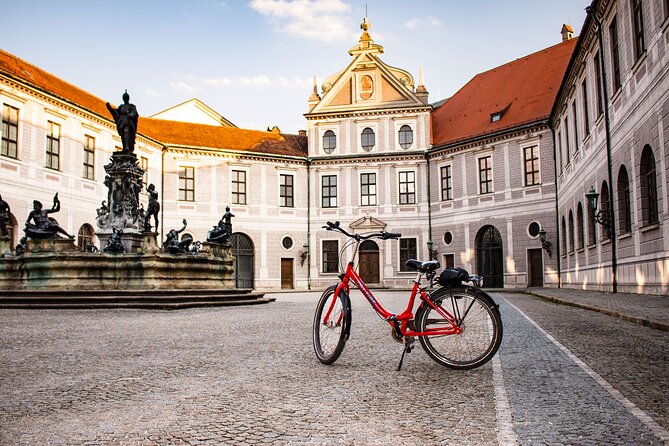
The Residenz München is the former royal palace of the Wittelsbach monarchs of Bavaria. It is described as the largest city palace in Germany, and it is open to visitors for architecture, room decorations, and displays of former royal collections. On a bike tour, you do not get the luxury of long gallery hours. Still, this stop gives you the big shapes and the courtyard energy so you can choose what to see later.
Next is the Hofgarten, a garden built between 1613 and 1617 in an Italian Renaissance style by Maximilian I. In the middle sits a pavilion for the goddess Diana, built in 1615. It is a nice contrast to the hard stone of the palace. Even in a short visit, it helps you understand why Munich built leisure space right next to power.
Then you add a modern government-adjacent layer with Bayerische Staatskanzlei. This building, erected from 1989 to 1993, wraps around the central dome of the former Bavarian Army Museum built in 1905, which had been demolished in World War II. That mix of old foundations and new architecture is a theme Munich keeps returning to.
English Garden to Chinese Tower beer garden: where the city relaxes
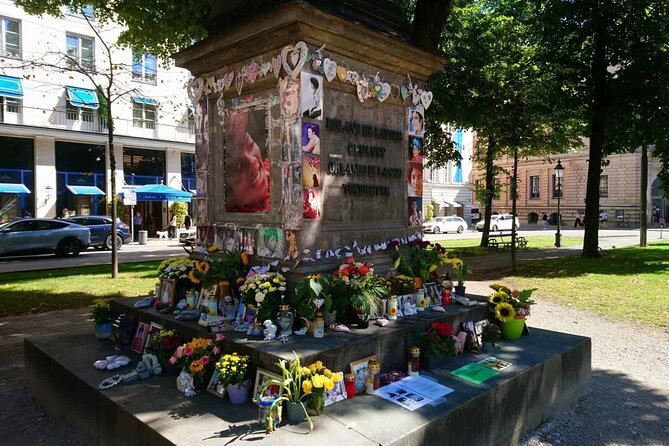
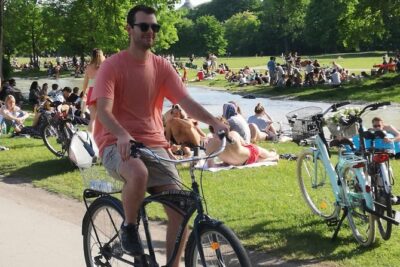
You then ride into the Englischer Garten, one of the world’s largest urban public parks at about 3.7 km² (370 ha). The name refers to the English-style garden approach, an informal landscape style popular from the mid-18th century to early 19th century.
This is where the tour stops feeling like a checklist and starts feeling like a city day out. You are moving from monumental architecture into open-air Munich life.
From there, you head to the Biergarten am Chinesischen Turm near the Chinese Tower. This beer garden is a Bavaria institution, with beer and food served at shared tables under trees. The details here are part of what makes it worth the ride: it has 7000 seating places, and it is described as the second largest beer garden in Munich after Hirschgarten. It sells Hofbräu beer and is one of the most famous tourist beer gardens in the city.
One note on budgeting: the tour includes the ride and guide, but food and drinks are not included. There is also the tour overview mentions a chance to sample traditional German beer at a legendary beer hall for an extra expense. So you can keep it light with a single beer garden stop, or spend a bit more if that beer-hall moment is your priority.
Eisbachwelle: watching surfers at the standing-wave edge of town
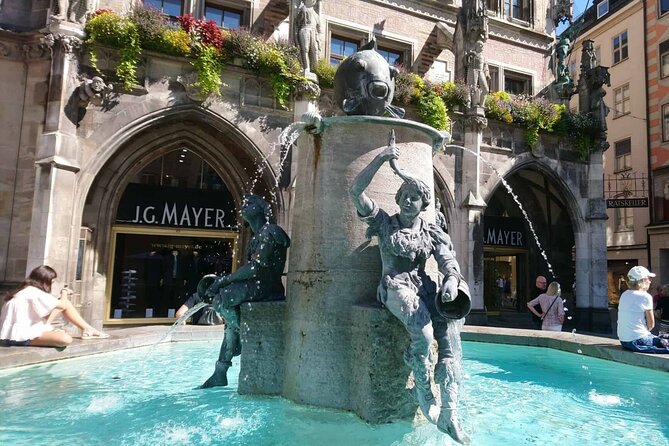
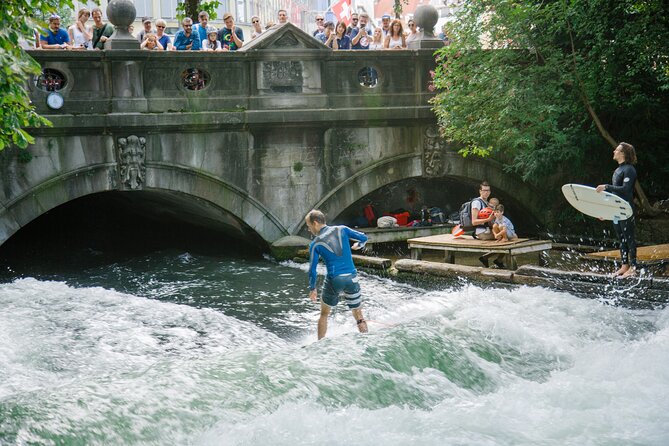
After the park and beer-garden pause, you roll by Eisbachwelle, a spot where the river forms a standing wave about one meter high. It is a famous river surfing location. The water is cold and shallow, sometimes only 40 cm deep, and it is only suitable for experienced surfers.
This stop is short, but it is memorable because it shows Munich has these pockets of street-style sport right inside the city. Even if you never plan to surf, you can watch the action and get that “how is this allowed here?” feeling.
Friedensengel, Maximilianeum, and the big science stop
Next comes the Friedensengel (Angel of Peace) in Maximilian Park. This is a viewpoint at the eastern end of a line of sight connected to Prinzregentenstrasse. Next to the Isar there is an open space with a fountain, plus water features including a dolphin spout and smaller spouts. Two staircases lead to the observation deck.
At the top is a 38-metre Corinthian-style column with a six-metre statue of the Angel of Peace. The statue is a replica of the Nike of Paeonius.
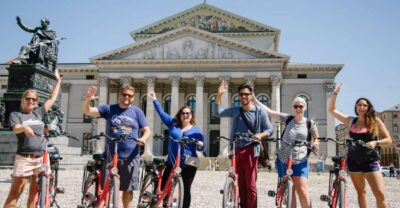
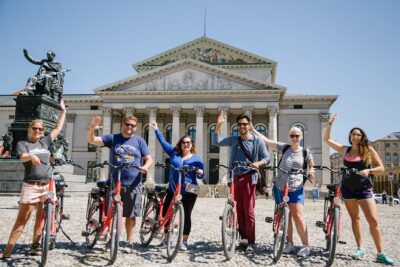
Then you move on to Maximilianeum, a palatial building that since 1949 has housed the Bavarian State Parliament. It is another “power and decision-making” point on the route, but now you are seeing it in a civic context instead of a royal one.
Finally, the tour hits the Deutsches Museum, described as the world’s largest museum of science and technology, with about 125,000 exhibited objects across 50 fields and around 1.5 million visitors per year. Again, the time is short. Use this stop to decide if you want a full day inside later. This museum is big enough that a quick look can only whet your appetite.
Viktualienmarkt and Ohel Jakob Synagogue: food culture plus modern faith in one loop
By this point, you should have that “Munich in layers” feeling. You switch from monuments to everyday culture with Viktualienmarkt. This market developed from a farmers market into a gourmet hub with 140 stalls and shops, selling flowers, exotic fruit, game, poultry, spices, cheese, fish, and juices. Even if you do not plan to buy much, it is a great place to smell the city and spot food you want to chase later.
The ride ends with a stop at the Ohel Jakob Synagogue. Built between 2004 and 2006, it is the new main synagogue for the Jewish community in Munich. It was inaugurated on 9 November 2006, the 68th anniversary of Kristallnacht. This is a quieter, more reflective stop, and it matters that the tour includes it because modern Munich is not only palaces and parks.
Beer hall sampling and how to keep the day on budget
The tour pitch includes an option to sample traditional German beer at a legendary beer hall for an extra expense. It is a nice add-on because it ties back to Munich’s beer identity and to the historical Beer Hall Putsch reference you already heard earlier around Odeonsplatz.
Here is how I would handle it for best value: set a cap before you start. If you do both the beer garden and the beer hall, you will probably spend more than expected, especially if you add food. If your goal is history first, do one beer-related stop and keep the rest for walking, photos, and market browsing.
Also, remember food and drinks are not included in the tour price. That is normal, but it affects the real-world total.
Should you book this Munich electric bike tour?
Book it if you want a fast orientation to Munich’s major districts, you like history that comes with architecture, and you want to avoid fatigue with electric bikes. This is a great choice for first-timers, couples, and even families with older kids who can follow a guided pace.
Skip it or plan carefully if your main goal is deep time inside major museums. The stops are short, and you will likely need a separate visit to get the full museum experience.
One last tie-breaker: if you care about guide style, this tour has been led by names like Rob, Cannan, Karl, Susanna, Suzanne, Mark, and Dan. If you are lucky enough to match with a guide who reads the group well and keeps the safety and timing tight, you will feel it from the first blocks.
FAQ
How long is the Best of Munich Electric Bike Tour?
It runs about 4 hours.
Where do you meet, and do you return to the same place?
The meeting point is Karlsplatz 4, 80335 München, Germany, and the tour ends back at the meeting point.
What is included in the tour price?
Your ticket includes a live guide and the electric bike and helmet.
Is the tour offered in English, and how big is the group?
The tour is offered in English. The group size is limited to a maximum of 20 travelers, and it may be mixed with non-ebikes.
Are food and drinks included?
No. Cost of food or drinks is not included. The beer hall sampling is also listed as an extra expense.
Can I cancel for a full refund?
Yes. You can cancel up to 24 hours in advance for a full refund. Canceling less than 24 hours before the start time is not refundable.
Recently added around Munich
- München: Vegetarische Viktualienmarkt-Probiertour Deutsch★ 4.8 · 6 reviews
- Private Transfer from Munich to Vienna with 2 hours for sightseeing★ 4.5 · 6 reviews
- Munich Walking Quiz: Explore and Discover the City’s Highlights★ 5.0 · 7 reviews
- Walking Tour on Resistance to Nazism in Munich★ 5.0 · 8 reviews
- 2 hour Sights Guided E-Scooter Tour in Munich★ 4.0 · 6 reviews
- Private Transfer from Munich to Salzburg with 2 hours for sightseeing★ 4.5 · 13 reviews
- From Munich: Neuschwanstein Castle and Linderhof Private Tour★ 5.0 · 13 reviews
- Paul’s Private Tour Munich Highlights★ 5.0 · 3 reviews
Munich Bike Tours, compared.
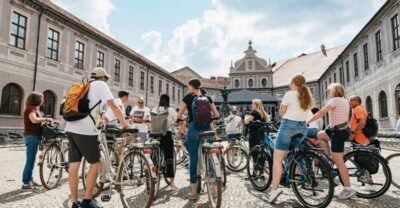
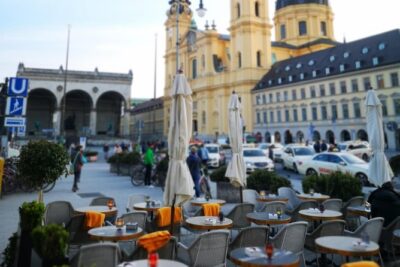
Classic Mike’s Bike Tour daily @ 11.30 incl Beer Garden & Surfers
Read our review →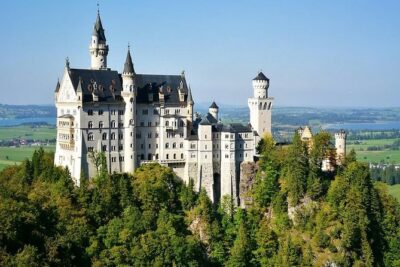
Neuschwanstein Castle by Bus Incl. Bike Ride or Hohenschwangau
Read our review →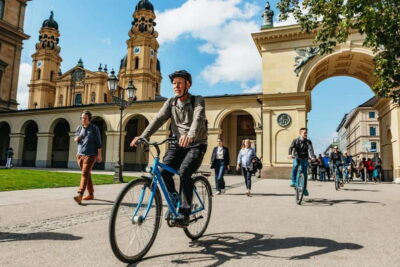
Classic Guided City Tour by Bike (English Tour Only)
Read our review →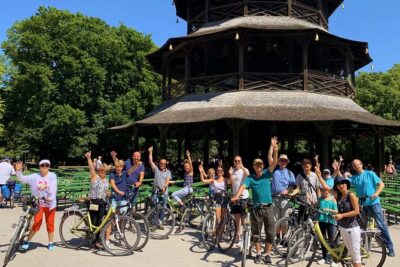
Mini Classic Bike Tour @ 4pm incl. Beer Garden & Surfers 2,5 hrs
Read our review →Browse the lists this tour appears in